Karma, the law of cause and effect, is one of the most profound and widely misunderstood principles in ancient Indian philosophy. Often associated with fate or morality, karma is neither. It is a precise system that governs how every thought, intention, and action shapes human experience. Rooted in very ancient Indian spiritual scriptures like the Bhagavad Gita and the Upanishads, karma operates as an underlying intelligence within existence itself.
The word “karma” comes from Sanskrit and simply means action. But in its deeper context, it includes not just physical actions, but also thoughts, emotions, and intentions. According to these ancient texts, nothing that arises within you is without consequence. Every movement of mind and body leaves an imprint and contributes to the unfolding of your reality.
In the Bhagavad Gita, karma is described as deeply complex, extending beyond visible actions into subtle inner processes. It distinguishes between conscious action, unconscious reaction, and inaction. This immediately challenges the common assumption that karma is a simple reward and punishment system. Instead, it is presented as a dynamic law of balance.
Before we go further deep , to experience the insight shared above beyond words, watch this reflection:
The Upanishads go even deeper. They explain that as a person acts and as they desire, so they become. This means karma is not just about external outcomes. It is about internal transformation. Every action creates a subtle imprint, known as “samskara,” which shapes perception, behavior, and future choices.
This reveals the underlying logic of karma. It functions through continuity. Nothing exists in isolation. Every experience is connected to previous causes, whether visible or hidden. What modern psychology describes as conditioning was recognized thousands of years ago as the accumulation of karmic impressions.
One of the biggest misconceptions is that karma is immediate. In reality, its results unfold across time. Ancient texts explain that some actions bear fruit instantly, while others take time to manifest. This delay often creates the illusion that actions go unnoticed. But within this system, nothing is ever lost. Every cause finds its effect when conditions align.
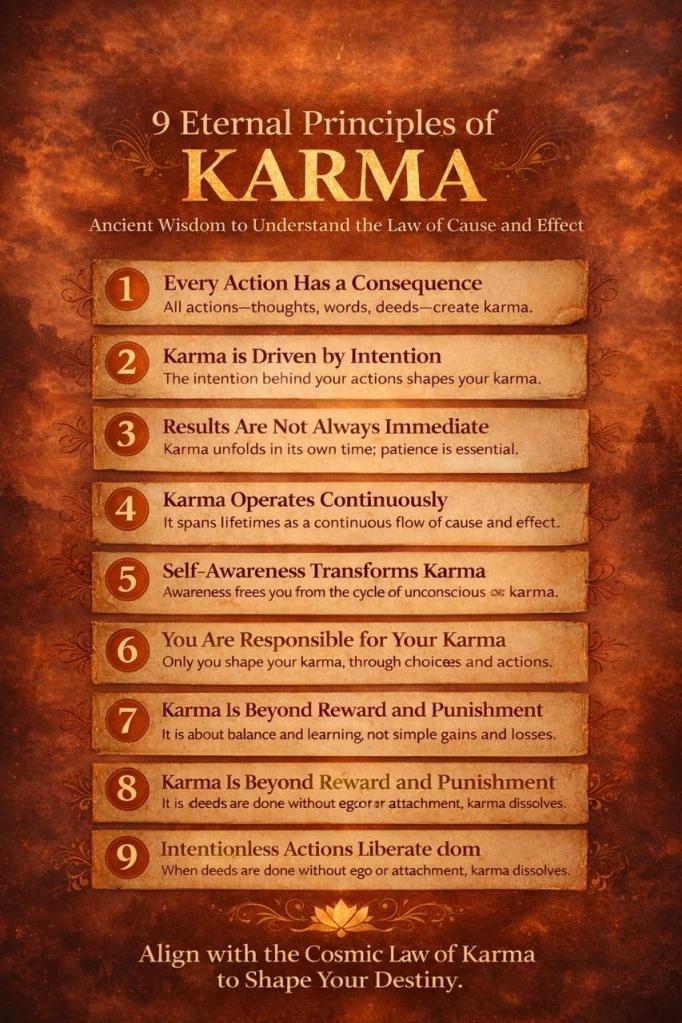
Another critical factor is intention. The same action performed with different intentions can create entirely different outcomes. This makes karma a conscious process rather than a mechanical one. It is not just what you do, but from where you act that determines the result.
Karma is also not a fixed destiny. It is fluid. The same scriptures emphasize that awareness can dissolve karmic patterns. When actions are performed without attachment to results, the cycle begins to break. This is known as “karma yoga,” a path where action continues, but the inner burden of accumulation drops.
At its core, karma is not punishment. It is balance. It is existence maintaining order through cause and effect. The system does not judge. It simply reflects.
The deeper realization is this. Karma is not happening to you. It is happening through you. Your reactions, habits, and patterns are all expressions of accumulated impressions. When awareness enters, these patterns begin to loosen.
Karma, then, is both a law and a doorway. For the unconscious, it binds. For the aware, it liberates.
For more raw, unfiltered spiritual creations, visit:
https://www.instagram.com/inside_out_with_rahul_yuvi
Precaution : These Spiritual Impressions will break your Ego .
……………………..
If this touched something within, let it flow into your mindfulness, deepen your meditation, and quietly become your way of living spirituality.
……………………..
 Inside Out With Rahul Yuvi